Using single-cell combinatorial indexing, we profiled the
transcriptomes of around 2 million cells derived from 61 embryos staged between 9.5 and 13.5 days of gestation, in a single experiment.
Posts Tagged ‘x78retwee’
The single-cell transcriptional landscape of mammalian organogenesis
February 28, 2019Small research teams ‘disrupt’ science more radically than large ones
February 28, 2019QT:[[”
“The authors describe and validate a citation-based index of ‘disruptiveness’ that has previously been proposed for patents6. The intuition behind the index is straightforward: when the papers that cite a given article also reference a substantial proportion of that article’s references, then the article can be seen as consolidating its scientific domain. When the converse is true — that is, when future citations to the article do not also acknowledge the article’s own intellectual forebears — the article can be seen as disrupting its domain.
The disruptiveness index reflects a characteristic of the article’s underlying content that is clearly distinguishable from impact as conventionally captured by overall citation counts. For instance, the index finds that papers that directly contribute to Nobel prizes tend to exhibit high levels of disruptiveness, whereas, at the other extreme, review articles tend to consolidate their fields.”
“]]
The Friendship That Made Google Huge | The New Yorker
January 24, 2019NPG 6591; Sir John Edward Sulston – Portrait – National Portrait Gallery
March 10, 2018A great loss. A portrait open to future annotation & elaboration…!
https://www.npg.org.uk/collections/search/portrait/mw57555/Sir-John-Edward-Sulston
This umbrella will keep you dry while riding your bike
February 4, 2018How the Bitcoin protocol actually works | DDI
April 2, 2017How…#Bitcoin…works, by @michael_nielsen
http://www.michaelnielsen.org/ddi/how-the-bitcoin-protocol-actually-works Overview focusing on why in addition to how; highlights #privacy issues
QT:{{”
How anonymous is Bitcoin? Many people claim that Bitcoin can be used anonymously. This claim has led to the formation of marketplaces such as Silk Road (and various successors), which specialize in illegal goods. However, the claim that Bitcoin is anonymous is a myth. The block chain is public, meaning that it’s possible for anyone to see every Bitcoin transaction ever. Although Bitcoin addresses aren’t immediately associated to real-world identities, computer scientists have done a great deal of work figuring out how to de-anonymize “anonymous” social networks. The block chain is a marvellous target for these techniques. I will be extremely surprised if the great majority of Bitcoin users are not identified with relatively high confidence and ease in the near future. The confidence won’t be high enough to achieve convictions, but will be high enough to identify likely targets. Furthermore, identification will be retrospective, meaning that someone who bought drugs on Silk Road in 2011 will still be identifiable on the basis of the block chain in, say, 2020. These de-anonymization techniques are well known to computer scientists, and, one presumes, therefore to the NSA. I would not be at all surprised if the NSA and other agencies have already de-anonymized many users. It is, in fact, ironic that Bitcoin is often touted as anonymous. It’s not. Bitcoin is, instead, perhaps the most open and transparent financial instrument the world has ever seen.
“}}
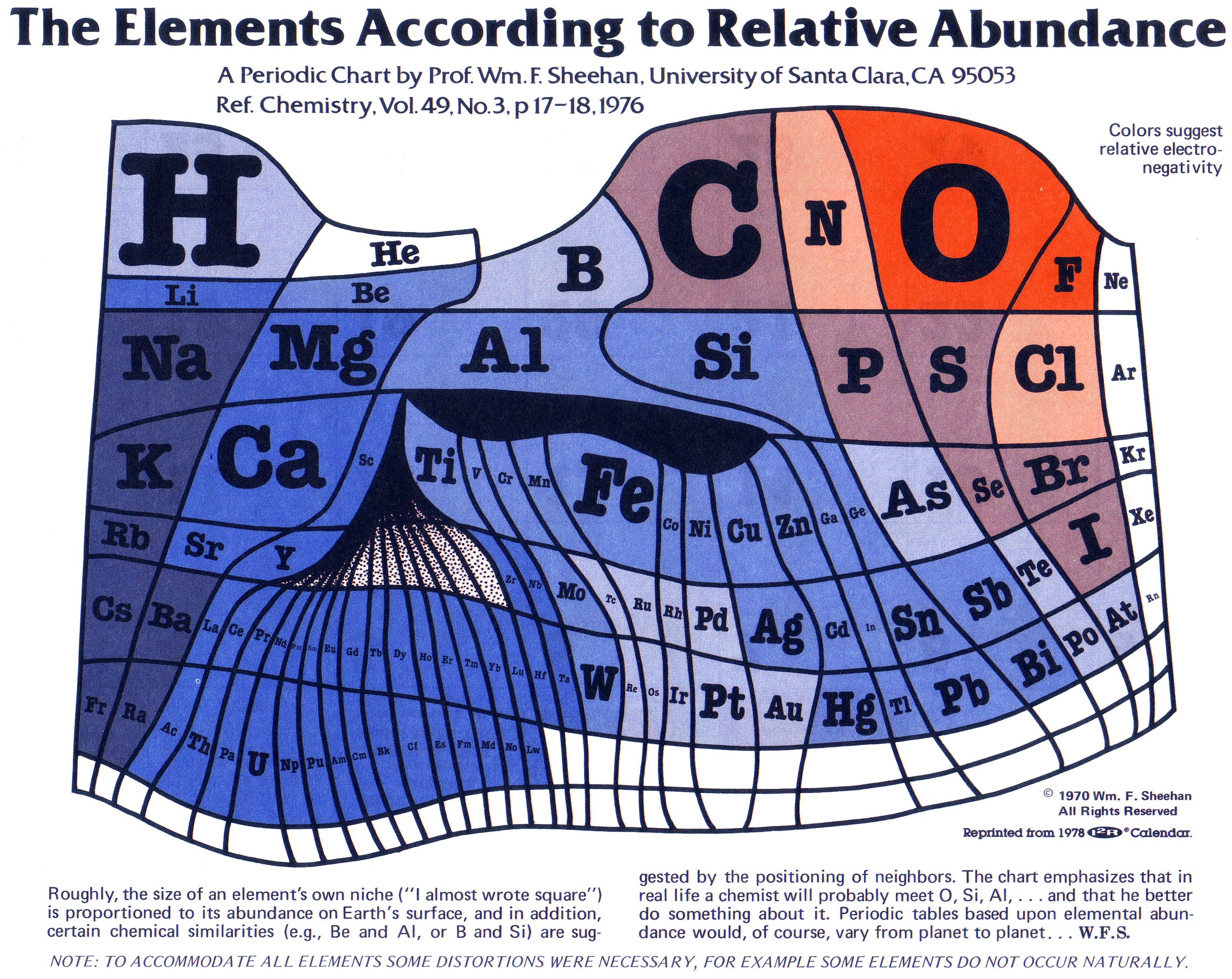
relative_abundance.jpg (3038×2414)
December 30, 2014Periodic Table, scaled to abundance on Earth http://bit.ly/1rlyfSx pic.twitter.com/n9Xbfoe8x1 Illustrates importance of 1st row HT @pickover
http://www.meta-synthesis.com/webbook/35_pt/relative_abundance.jpg
 linkstream2 microblog